“Until death do us part” has a different meaning in Thailand.
Every culture has a hierarchy of three things: nationhood, family and religion
Having grown up in the US in the 60s, this hierarchy was
like a close grouping of bullets over the heart – there was no real hierarchy
just a bulls eye. Gold star mothers gave
their sons (and a few daughters) to the cause of nationhood in the religious
belief, not just that God was on their side, but that the country was a force
for good and stability in the world. After
all we had just been through World War II and now Russia was destabilizing
Europe with its repressive Iron Curtain.
And because the religion of Communism was the worship of the nation, it
was our nation against theirs.
The inability to see any separation between nation, family
and religion was a reason why political disagreement use to always stop at our
shores. When events happened overseas,
the US always acted as one. Times have
clearly changed and America has changed, too.
Religion for one thing is not the factor it was in 1960. But right or wrong, I still ascribe to the
idea that America should show a united front to foreign countries. I may hang fire all over the auditorium about
the wrongheaded failure of President Obama on domestic issues, but I refuse to
criticism him on foreign policy. “You
think you could do a better job, go for it,” is part of this reluctance, but
most of it is my retro belief in America as should act as a whole, as one
people.
Other counties, however, that I know have much different
hierarchies.
In Saudi Arabia there is no doubt that religion is at the
top of any hierarchy and overwhelms family and nationhood. Family, I would say, comes in at a distant
second to religion, although strong tribal affiliation which is not what I mean
by family - more like I am a Native American - blurs this. For instance, I once visited the home on base
of a high ranking naval officer. When
his eight year old daughter appeared, I said something like what a pretty girl
and he absolutely ignored her and my reference to her. If he hadn’t have spent years in the US, his
religion would have mandated that he throw me out of his house altogether for
such a comment about a female. The third
component, a sense of nationhood, is virtually lacking altogether in Saudi. The
Saudis do have a national day (like our Fourth of July), but the celebrations
are very muted and met with a collective yawn.
Thailand is also different.
Religion and a tribal sense family share the top spot, but
nationhood is fragmented between the urban rich and rural poor. Nationhood in Thailand is still a work in
progress and hard to place on any hierarchy.
But just as you are never far away from a mosque in Saudi Arabia, so too
are you never out of walking distance of a wat in Thailand. This similarity between the two countries,
however, masks a striking dissimilarity.
Patriarchy versus matriarchy
Saudi Arabia is a patriarchy while Thailand is a
matriarchy. Only men pray at mosques in
Saui. Some mosques have small hidden
galleries for women, but a woman prays at home is a safe generalization. All Thai Buddhist men become monks (if money
and other things allow). If after
leaving the monkhood, they return to the wat it is most likely as a monk. My brother-in-law (a nice guy) has returned
to his wat for two weeks or so much as a westerner might go on a spiritual
retreat. Here he essentially becomes a
monk again. He has is head shaved anew and
dons the robes of monk renewing his vows
Women are the wat goers in Thailand and more so than women are the
church goers in the US. Men do go to
wats on religious days (usually a couple of days a month), but women outnumber
them.
The following is an aside about Saudi Arabia but on point.
[When I got a driver’s license in Saudi, the official DMV
form wanted to know my name, my father’s name, and my grandfather’s name. There was no block for that other parent
person’s name. Many Saudi young men that
I met could recite the names of their fathers all the way back to Mohammed
(PBUH). I am not kidding here. Now, I knew the name of my maternal
grandfather’s name, but because my father never talked of his father, I did not
know my paternal grandfather’s name. My
Saudi minder at the DMV couldn’t believe this.
He almost swooned and fell on the floor from disbelief. I could almost hear him saying infidel!
Infidel! Finally, we settled on the name
Frank. My minder was relieved and
pleased that I was not going to cause a problem or an incident.]
Go into a Saudi house and you will see the picture of the
family patriarch in the place of honor (and never any female pictures). Go into a Thai house and you will see the
picture of the king in that same place of honor, along with family pictures
galore. The King is the titular man of
the house – his birthday is the occasion for Father’s Day in Thailand. Do you see any differences here?
Just as Saudis deem male names all important, the Thais
really don’t care. A Thai name can be
either a male name or a female name – this can be delightful but maddening,
too. While we just use I for the first
person singular, the Thais use pom (male) or chan (female). In the third person, however, where we expect
a he or she, they just use khow. There
is also a third sex in Thailand, called by many names, but essentially is a boy
who has decided to live his life as a woman.
I find this group almost indescribable.
Saudi, I am sure, has more than its share of homosexuals, but I doubt
there is a ladyboy in the country.
Both the Saudis and the Thais like to pack people together
tooth to jowl in a way that is just frightening to a westerner. The Hajj may have over a million people
packed into Mecca, and I think I’ve been in an alleyway in a shopping district
of Bangkok with about as many people.
While the Saudis really only have two religious celebrations (Hajj and
Ramadan), the Thais have three family celebrations in which religion plays a
major part.
Three Thai parties
The first two parties celebrate what I recognize as family and
what I recognize as religion.
The Thais celebrate weddings and these are very much like
western weddings. They are expensive,
high spirited, formal and good fun. The
Thais also celebrate a son going into a wat to become a monk. In the west we often say that nuns are
married to the church or to Jesus. When
a Thai boy becomes a monk, he often rides in the back of a pickup with his
father supporting an umbrella to keep the sun off his newly shaved head. I do not mean any disrespect here, but the
new monk is dressed in what looks to me to be a very fancy, white wedding dress. He goes into the wat and the next time you
see him he is wearing a very humble saffron robe. The monks’ part in all Thai
celebrations is to say prayers and get out of the way of the family.
The third Thai party celebrates the tribe.
The third Thai party is the funeral part or nang soat – this
is the one that drives me crazy. The
Saudis bury the dead within twenty-four hours and there is not much if any
formal ceremony. I saw a big post-hole
digger in a Jubail cemetery (east coast of Saudi). Bore a hole, wrap the body in white and stand
the body upright in the hole, gather a very few family men to say prayers – and
that’s it. This works for royalty as it
does for the rest of us. It’s brutal,
but so is death and I confess it makes sense to me as a man.
The Thais on the other hand take a least a week of partying,
day and night, to get someone cremated. I
use the word party because that seems most appropriate even though there is no
booze (there is music however). Then, there is a party the day after and one
at a hundred days . . . and on and on (or so it seems to me).
When I was very ill I went into the kitchen where Chuwat (my
wife’s 103 year-old grandfather and my friend) lay for his last few weeks. I saw that an aunt (who I did not know) had
laid him out holding some flowers in his hands.
She made a go-away gesture to let me know he had passed and I almost
swooned . . . because I knew what was coming having been through the funeral of
my wife’s father. I swore back then that
I would never be in the house having another funeral. Luckily this time I went into the hospital
for five or six days and missed the partying altogether.
Women run the funeral parties. It’s their chance to shine. They cook for a hundred or so people five
days in a row, breakfast and supper. I’m not joking here, either. The fact that most of the “mourners” don’t eat
much makes no difference.
When I was in the hospital, my wife came to see me only once
(that I remember) and then with friends and only for an hour or so. She couldn’t stay and relegated that task to
her eighteen year old daughter (someone from the family has to be with the
patient at all times in a Thai hospital).
She couldn’t stay because she was the grand master of Chuwat’s
funeral. (Let me be clear: there’s
something to my wife being the oldest daughter and therefore responsible for
such things. Also, her own mother,
daughter of the deceased, was not up to the task. I also realize that funerals in the west are equally
quirky, but these rural Thai funerals are just too much.) I chalk this extravagant display up to this
being a matriarchal society unwilling to give up something which from time out
of mind has been within the domain of women.
Last week, my wife’s aunt (she has literally hundreds of
unnamed-to-me aunts) died in a town about a two hours’ drive from here and [BAM!]
away she and her mother went. They probably
went because all the relatives were just down her for Chuwat’s funeral and not
to go would have been an insult. But
they were needed up there to get things right, “donchaknow” (as my grandmother
might say). My wife’s oldest daughter
went too, but came back with the car the same night. She and her 18 year-old younger sister went
shopping the next day. This left me
alone with the ghost of Chuwat for the next couple of days.
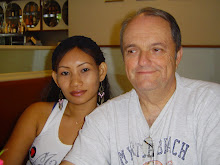
I, alas, am a member of the family, but not a member of the
clan. Until death do us part has a
different meaning in Thailand.
posted by Forrest at
8:20 PM



0 Comments:
Post a Comment
Subscribe to Post Comments [Atom]
<< Home